Did We Save Time, or Just Move the Work?
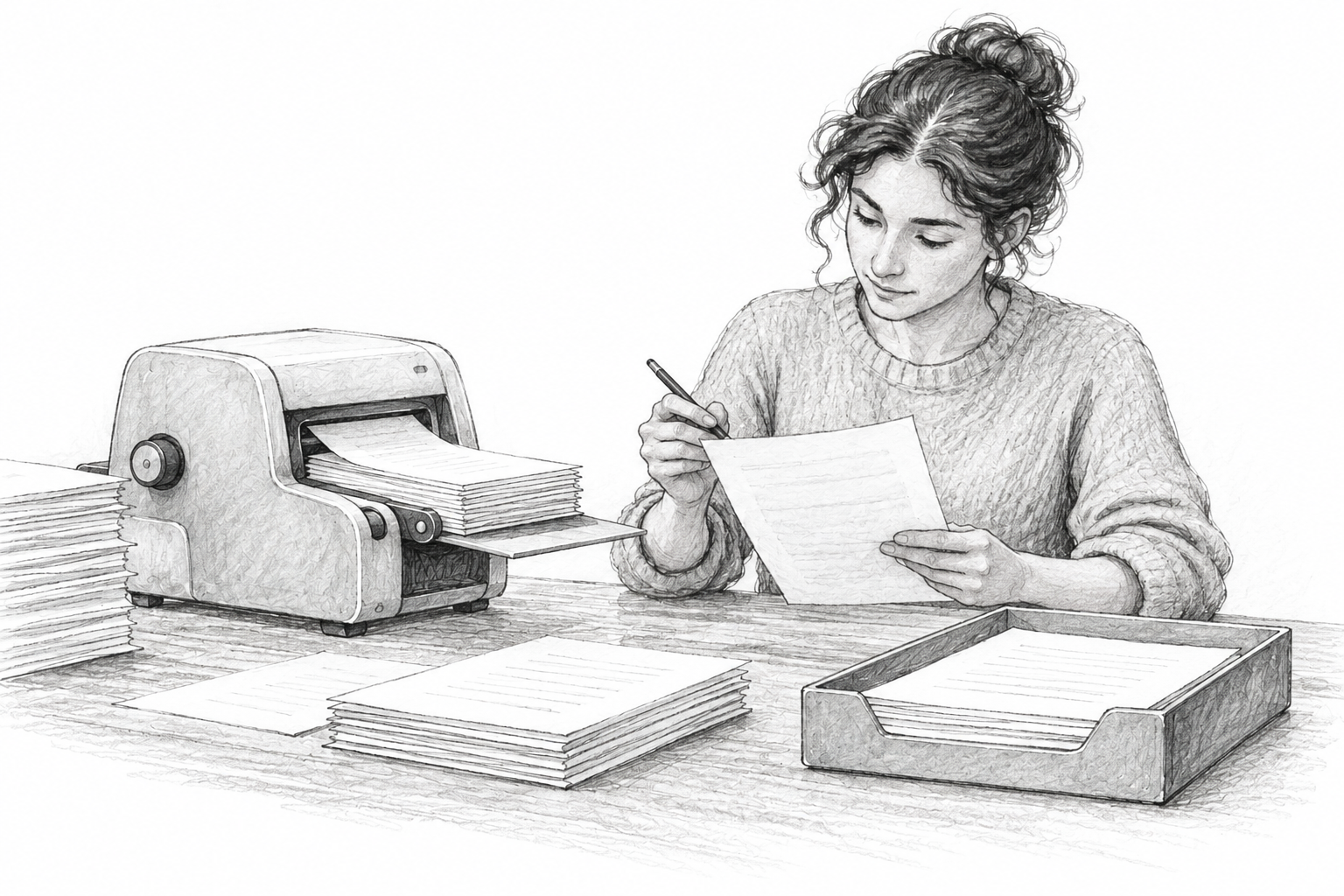
A finished draft can feel like a finished task. For the person who must check it, the work may just be beginning.
That gap interests me when I think about automation. The appeal of getting repetitive preparation off someone's desk is easy to understand. I find the saving more convincing when it also accounts for what happens after the draft arrives.
I look at this through the lens of logistics and operations: one person's completed task can be the starting point for somebody else. The quality of that handoff matters. So does the effort it asks of the person receiving it.
Imagine a small community putting together a weekly list of free public lectures and online learning events. One volunteer uses an AI assistant to find sessions on university and library websites, write short descriptions, and produce an orderly list. An organizer checks it before publication.
The preparation looks much quicker. Yet the organizer still has to establish whether registration is open, whether an event really is free, and which time zone applies. One listing contradicts another. A session sounds relevant until the organizer opens the original page and discovers it is intended for a different audience.
Nothing dramatic has happened in this imagined example. There is simply more judgment inside a modest task than the neat final list suggests.
If the organizer ends up repeating the original search, part of the work has moved. The assistant has produced a starting point, and someone else has inherited the uncertainty. Calling that a saving without considering both people's effort would leave me unconvinced.
It is a useful extension of the questions worth asking before you build: whose effort have we counted, and whose have we left out?
The value of the work that remains
Still, moving work can be a good exchange. Reviewing a structured draft may be easier than searching, selecting, and writing from an empty page. A useful first version can free attention even when the reduction in minutes is small. Someone else may be better placed to make the final judgment.
There could also be a quality gain. The organizer might spend more time considering whether the events belong together and less time copying dates between websites. The total effort might stay similar while the list becomes more useful. I would consider that a worthwhile possibility, provided the benefit is described honestly.
What troubles me is when the checking becomes hard to see. The person preparing the draft notices the time recovered. The person receiving it quietly absorbs the verification. Both can give an accurate account of their own work and still arrive at different conclusions about whether the change helped.
That difference seems worth understanding before deciding that one of them is resistant to change. The burden may also feel different: a few minutes of concentrated checking just before publication can matter more than a longer task that someone could previously do at their own pace.
At the same time, reviewing everything forever can become its own problem. If an automated process has earned confidence in a narrow, stable task, repeating every step manually may erase much of the reason for using it. I would be reluctant to treat the amount of checking as proof of the quality of the checking.
For the events list, a clear source beside each entry could make review more focused. The OECD AI Principles connect accountability with being able to trace data, processes, and decisions. I see a practical value in that idea: the organizer can examine the uncertain detail without reconstructing how the whole list was assembled.
Even then, the balance can change. A familiar source may change its format. A new organizer may need more context. A process that was easy to check last month may require more attention now. The monitoring emphasis in GAO's AI Accountability Framework makes sense to me for that reason. An early improvement is a starting point for understanding the result over time.
This leaves me with a more demanding view of saved time. I want to know whether useful effort disappeared, unnecessary effort disappeared, or the effort simply landed somewhere less visible. Those are different outcomes, even when the first draft arrives equally quickly.
For me, being someone people can count on includes being honest about how much checking a result still needs. It also means being open to the possibility that a familiar check has stopped adding much value.
My current view is that automation earns a stronger claim when the people producing the output and the people relying on it can both explain what improved. Sometimes that will be less work overall. Sometimes it will be better work with a visible cost in review. I would want to know which promise I was making.
Which part of the checking would you be reluctant to lose, and what would convince you that another part no longer earns its time?